
Japan Rail Pass 2026: Is It Worth Buying, or Should You Use an IC Card Instead?
This article contains affiliate links. We have an affiliate partnership with Klook, established September 1, 2026. We have no partnership with jrpass.com or the official JR Group site (japanrailpass.net). If you buy through our Klook link, we may earn a commission at no extra cost to you, and it does not change what we recommend — including the verdict below that many travelers are better off without the pass. Details
For a city-focused stay, choose Suica or ICOCA for local travel; for a single Tokyo–Osaka return or the western Japan circuit shown below using JR West's foreigner discount, choose individual shinkansen tickets plus an IC card. For a multi-city itinerary, choose the Japan Rail Pass only when your individual fare total exceeds the pass price, accounting for any Nozomi or Mizuho supplements. If you choose the pass and want to avoid postal delivery, use the official JR Group online purchase route; jrpass.com suits travelers who want a physical Exchange Order before departure, while Klook may suit travelers already booking other Japan activities there.
Key facts
- Best for city-focused stays: Suica or ICOCA.
- Best for multi-city travel when individual fares exceed the pass price: Japan Rail Pass.
- Cheapest shinkansen option in the worked western Japan circuit, with the qualifying discount: JR West foreigner one-way tickets, ¥25,100 in total.3
- 7-day Ordinary adult pass price confirmed: Japan Rail Pass, ¥50,000.1
- No-postal-delivery purchase route confirmed: official JR Group online purchase.6
- Prices checked: 2026-09-02 (JR Pass); 2026-08-29 (JR West foreigner one-way tickets).13
Which one, at a glance
| Best for | Recommendation | Why |
|---|---|---|
| City-focused stays | Suica / Welcome Suica or ICOCA | Local transport payment without the nationwide pass cost.45 |
| A single Tokyo–Osaka return | Individual JR tickets plus an IC card | The worked Hikari estimate and confirmed Nozomi fares both fall below the pass price.19 |
| The worked western Japan circuit with Temporary Visitor status | JR West foreigner one-way tickets plus an IC card | The discounted shinkansen subtotal is below the pass price.13 |
| Multi-city trips whose individual fare total exceeds the pass price | Japan Rail Pass | Covered JR travel can justify the pass; account for Nozomi/Mizuho supplements.12 |
| Pass buyers avoiding postal delivery | Official JR Group online purchase | Collect the pass in Japan using a reservation number and passport.6 |
| Pass buyers wanting a physical Exchange Order before departure | jrpass.com | The retailer mails the Exchange Order for exchange in Japan.6 |
| Pass buyers already booking Japan activities on Klook | Klook | The pass is listed there; refund policy and mailed-document format remain unconfirmed.8 |
Sources: JR Group prices and JR Central fares19 (checked 2026-09-02); JR Group supplementary tickets and purchase instructions, jrpass.com purchase instructions, JR West discounted tickets and ICOCA, JR East Suica23456 (checked 2026-08-29); Klook product page8. Checked 2026-09-01.
View official JR Group purchase page →View official jrpass.com purchase page →View Klook JR Whole Japan Rail Pass (affiliate link) →View official Suica / Welcome Suica page →View official ICOCA page →View official JR West one-way ticket page →View official JR Central fare comparison page →
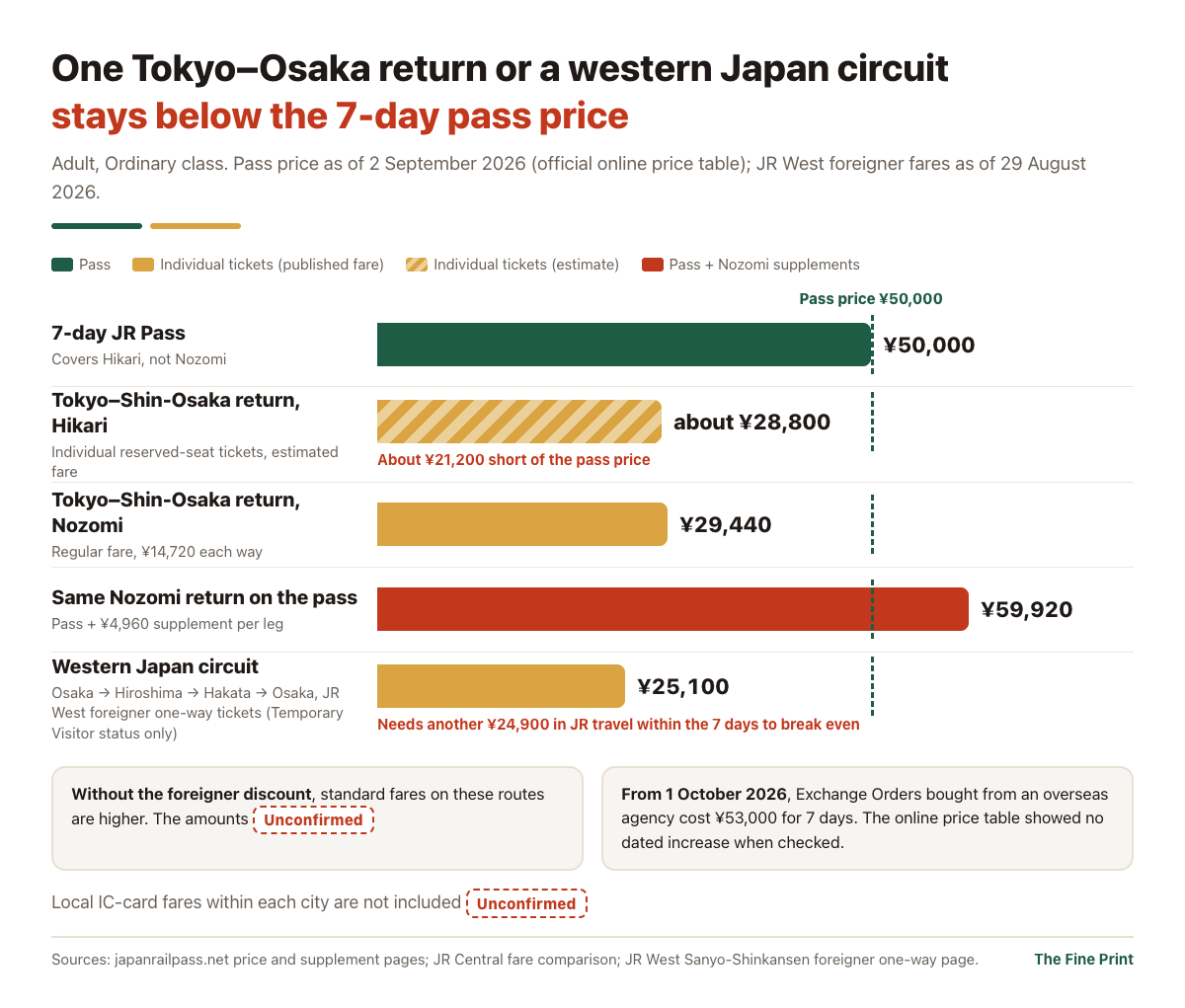
The 7-day Japan Rail Pass costs ¥50,000. A single Tokyo–Osaka return by Hikari runs about ¥28,800 in individual tickets — it does not reach the pass price on its own. The pass pays off when your itinerary spans three or more cities on long-distance shinkansen routes. One constraint: the fastest Nozomi service is not included in the standard pass; pass holders who board it pay a ¥4,960-per-leg supplement at a JR station counter.
Prices checked 2 September 2026. The JR Pass price change on 1 October 2026 is noted below.
This comparison covers who the pass makes financial sense for, when an IC card or individual tickets are the better choice, and how to calculate your own route using confirmed 2026 fares.
What the Japan Rail Pass Actually Covers
The Japan Rail Pass (JR Pass) is a fixed-price, unlimited-ride ticket valid on most trains operated by the six regional JR companies across the country. You pay once before you travel and then board any covered train without buying an individual ticket. The covered services include limited-express trains, most shinkansen (bullet trains), overnight sleepers, and the JR ferry to one island route.
The key word is "most." Two of the fastest shinkansen services — Nozomi on the Tokaido/Sanyo/Kyushu Shinkansen and Mizuho on the Sanyo/Kyushu Shinkansen — are not included in the standard pass.2 You can still board Nozomi or Mizuho if you hold a valid JR Pass, but you must purchase a supplementary ticket at a JR station: the "[ONLY WITH JAPAN RAIL PASS] NOZOMI MIZUHO Ticket" costs ¥4,960 for the Tokyo–Kyoto segment and ¥4,180 for Tokyo–Nagoya.2 That ticket goes on sale one month in advance and is valid only on the day of travel.2 The slower Hikari, Sakura, Kodama, and Tsubame services are fully covered at no extra charge.
On most itineraries where speed is not the priority, Hikari reaches the same destinations as Nozomi — just somewhat slower on the Tokyo–Kyoto segment. If your schedule has flexibility, the standard pass covers everything you need.
Japan Rail Pass 2026 Prices
Prices below were confirmed on the official price page on 2 September 2026. A price increase took effect on October 1, 2026, applying only to Exchange Orders bought from overseas travel agencies; the online purchase table carries no date condition. The section on the increase below explains what that means for what you pay.1
| Pass Type | Duration | Adult | Child (ages 6–11) |
|---|---|---|---|
| Ordinary (reserved or unreserved) | 7 days | ¥50,000 | ¥25,000 |
| Ordinary | 14 days | ¥80,000 | ¥40,000 |
| Ordinary | 21 days | ¥100,000 | ¥50,000 |
| Green (first class) | 7 days | ¥70,000 | ¥35,000 |
| Green | 14 days | ¥110,000 | ¥55,000 |
| Green | 21 days | ¥140,000 | ¥70,000 |
Sources: JR Group official price page and jrpass.com1. Checked 2026-09-02.
Child fares are exactly half the adult price for each tier.1 There is no senior discount listed on the official purchase page at the time of writing.
Who the Japan Rail Pass Is Right For
The JR Pass makes financial sense when the sum of the individual train tickets you would otherwise buy exceeds the pass price. In practice, this tends to happen for travelers who:
Cover three or more cities in a single trip, using shinkansen between each stop. A trip covering the Kanto region, Kansai, and Hiroshima or Kyushu involves multiple long-distance shinkansen journeys. Standard fares on each leg are steep, and the cumulative total can easily exceed ¥50,000 within a week.
Travel in a group with children aged 6 to 11. At half the adult price, child passes cost ¥25,000 for 7 days. A family of two adults and two children will often find four passes cheaper than buying individual shinkansen tickets for the same routes.
Plan to use JR local and limited-express trains frequently alongside shinkansen. The pass covers regional JR services, not just the bullet train. A traveler who also uses JR limited-express trains to reach airports, coastal areas, or destinations not on a shinkansen line picks up value that a shinkansen-only comparison overlooks.
Prefer the convenience of boarding without buying individual tickets each time. This is not a financial argument, but it is a practical one: the pass simplifies boarding when traveling through multiple stations in a single day.
Who the Japan Rail Pass Is NOT Right For
The pass is unlikely to be worth the cost in these situations:
Single-city stays. If you are spending your entire trip in one metropolitan area and using local subways and buses, an IC card will serve you at a much lower cost. The JR Pass does not cover subway lines operated by municipal governments or private rail companies, which handle most urban commuting in major cities.
Short trips focused on one region. A five-day trip to Kyoto and Osaka, with no long-distance shinkansen travel, will not come close to ¥50,000 in rail fares. Local JR urban lines in those cities charge fares in the hundreds of yen per trip, not thousands.
Travelers whose calculated fare total falls below the pass price. If you calculate your individual fares (see the sample calculation section below) and the total comes out to ¥35,000, buying individual tickets is the straightforward choice.
Day-trippers from a single base. If you are staying in one city and making day trips by shinkansen to one or two nearby destinations, check the round-trip fares before assuming the pass is needed. A single day trip may not justify the daily cost implied by a 7-day pass at ¥50,000 (roughly ¥7,143 per day of valid travel).
JR Pass vs. IC Card: Which Fits Your Trip?
An IC card — Suica (issued by JR East) or ICOCA (issued by JR West) — is a rechargeable contactless payment card that works on local trains, subways, buses, and even some convenience stores and vending machines. The two are mutually compatible: a Suica card works on ICOCA-compatible networks and vice versa.4
What an IC card covers: Urban rail within the metropolitan areas where it is valid, plus some regional JR local trains. Suica is valid in the greater capital-area network and also works on select networks in cities such as Sendai, Niigata, and Aomori, though you cannot use a single card to ride continuously across those separate regional zones.4
What an IC card cannot do: You cannot use an IC card to board a shinkansen reserved seat. If you want to travel by bullet train, you must purchase a separate shinkansen ticket — either individually at the station or through an online booking system — regardless of whether you have an IC card.4
When to choose IC card over JR Pass: If your itinerary is confined to a single major metro area for most of your trip, an IC card is sufficient and far cheaper. A general Suica card can be loaded in denominations of ¥500, ¥1,000, ¥2,000, ¥3,000, ¥5,000, or ¥10,000 at a time (cash only, not credit card) up to a maximum stored value of ¥20,000.4 Tourists can also buy a Welcome Suica, which requires no deposit, is valid for 28 days, and is designed specifically for short-term visitors.4
In Kansai, you can pick up an ICOCA card at the Kansai Airport station JR ticket office for ¥2,000, of which ¥500 is a refundable deposit. You will need a foreign passport and Temporary Visitor status; each traveler may purchase one card.5
The realistic hybrid: Many travelers find that an IC card for urban mobility combined with individual shinkansen tickets for intercity travel is more economical than the JR Pass for trips that involve two or fewer shinkansen routes. The IC card is not a competitor that replaces shinkansen travel — it replaces urban rail costs that the JR Pass does not cover particularly well anyway.
JR Pass vs. Buying Individual Tickets at the Station or Official Website
Klook was originally planned as the comparison source for individual shinkansen tickets. At the time of research (August 2026), Klook's product pages for individual reserved-seat shinkansen tickets returned errors or could not be located through their search interface, and no pricing or route information could be verified. This section covers direct purchase through JR stations or the JR West official website instead — which is how most travelers who skip the JR Pass actually buy their shinkansen tickets.
JR West's foreigner discount one-way ticket. For short-term visitors (Temporary Visitor visa status), JR West offers a discounted one-way shinkansen ticket on the Sanyo Shinkansen between Osaka/Kobe and Hakata. These are not standard fares — they are priced below the regular rate and require a qualifying visa status.3
Confirmed prices for the Sanyo-Shinkansen foreigner one-way ticket:3
| Route | Price |
|---|---|
| Osaka → Hiroshima | ¥7,900 |
| Hakata → Hiroshima | ¥6,300 |
| Osaka → Hakata | ¥10,900 |
Sources: JR West Sanyo-Shinkansen foreigner one-way ticket page3. Checked 2026-08-29.
Standard fares on these routes are higher than the foreigner discount prices shown above.
When to choose individual tickets: If your itinerary is limited to western Japan — the Kansai to Kyushu corridor — and you qualify for the JR West foreigner discount, individual tickets may be significantly cheaper than the 7-day JR Pass. The sample calculation below shows this in concrete terms. For routes on the Tokaido Shinkansen (Tokyo to Nagoya/Kyoto/Osaka), standard fares are set by JR Central and are not confirmed in this article. Check the JR Central website (jr-central.co.jp) or a JR ticketing office for current fares on that corridor before deciding.
Sample Calculation: A Western Japan Circuit
This calculation uses only prices confirmed from primary sources as of August 2026.
Scenario: A solo traveler on a 7-day trip, arriving and departing through Osaka (Kansai Airport), with stops in Hiroshima and Hakata (Fukuoka).
Option A — Individual tickets using the JR West Sanyo-Shinkansen foreigner one-way discount:
| Leg | Ticket | Cost |
|---|---|---|
| Osaka → Hiroshima | Foreigner one-way | ¥7,900 |
| Hiroshima → Hakata | Foreigner one-way | ¥6,300 |
| Hakata → Osaka | Foreigner one-way | ¥10,900 |
| Shinkansen subtotal | ¥25,100 |
Sources: JR West Sanyo-Shinkansen foreigner one-way ticket page3; subtotal calculated from the listed fares. Checked 2026-08-29.
Add IC card travel (Suica or ICOCA) for local trains within each city. Individual local fares were not confirmed for this article; local JR urban and subway fares are typically in the low-hundreds-of-yen range per trip.
Option B — 7-day JR Pass Ordinary: ¥50,000
The pass covers all three shinkansen legs above, plus unlimited JR local trains for the full 7 days.
What the numbers show: At foreigner discount prices, the three shinkansen segments cost ¥25,100 — roughly half the 7-day pass price of ¥50,000. To break even against Option A, the traveler would need another ¥24,900 in JR travel over the 7-day window.
Important caveat: The foreigner discount prices are below standard fares. If the same traveler cannot use the discount (for example, because they do not hold Temporary Visitor status, or the discount is not available for their specific travel dates), the standard fares on those routes would be higher, and the gap between Option A and Option B would narrow.
Sample Calculation: A Tokyo–Osaka Round Trip
This calculation uses prices confirmed or estimated from primary sources on 2 September 2026. The regular Nozomi fare for Tokyo to Shin-Osaka is confirmed directly from the JR Central website. Hikari fares on this corridor are estimated — Hikari runs about ¥320 cheaper than Nozomi.9
Scenario: A solo traveler making one return trip between Tokyo and Shin-Osaka.
Option A — Individual tickets on Hikari (covered by the standard JR Pass):
| Leg | Fare |
|---|---|
| Tokyo → Shin-Osaka (Hikari, reserved seat) | about ¥14,400 (estimated) |
| Shin-Osaka → Tokyo (Hikari, reserved seat) | about ¥14,400 (estimated) |
| Round-trip total | about ¥28,800 |
Sources: JR Central fare comparison and Smart EX reserved-seat fare PDF9; Hikari fares and round-trip total are estimates. Checked 2026-09-02.
Option B — 7-day JR Pass Ordinary: ¥50,000
The pass covers both Hikari legs at no additional per-journey cost.
What the numbers show: A single Hikari round trip costs about ¥28,800 in individual tickets — about ¥21,200 short of the 7-day pass price of ¥50,000. A Tokyo–Osaka return alone does not reach the pass price. The pass breaks even on this route only if other JR travel within the same 7-day window adds at least ¥21,200.
If you want Nozomi (the fastest service, not covered by the standard pass):
Pass holders who board Nozomi must buy a supplementary ticket at a JR station counter: ¥4,960 per leg for trips between Tokyo or Shinagawa and Shin-Osaka (the same price applies for the Tokyo–Kyoto leg).2 The ticket is sold at station counters only — not online — up to one month in advance, and is valid only on the day of travel.2
| Individual Nozomi tickets | 7-day pass + Nozomi supplement | |
|---|---|---|
| Tokyo → Shin-Osaka (Nozomi, regular fare) | ¥14,7209 | ¥4,960 supplement |
| Shin-Osaka → Tokyo (Nozomi, regular fare) | ¥14,7209 | ¥4,960 supplement |
| 7-day pass | — | ¥50,000 |
| Total | ¥29,440 | ¥59,920 |
Sources: JR Group official price page1, JR Group/JR Central Nozomi supplementary ticket pages2, JR Central fare comparison9; totals calculated from the listed prices. Checked 2026-09-02.
Buying individual Nozomi tickets (¥29,440) costs ¥30,480 less than the pass-plus-supplement combination (¥59,920) for a single round trip. A Tokyo–Osaka return does not justify the 7-day pass on either Hikari or Nozomi.
Do the Math for Your Own Trip
If you have multiple shinkansen legs, a route calculator tool on another site can give a fast result. Running the steps manually takes a few minutes and makes the assumptions explicit.
- List every long-distance leg. Write down the origin, destination, and shinkansen service for each segment (Hikari, Nozomi, Kodama, etc.).
- Look up the regular reserved-seat fare for each leg on the official JR site for that corridor: global.jr-central.co.jp for the Tokaido Shinkansen (Tokyo to Osaka), westjr.co.jp for the Sanyo Shinkansen (Osaka to Hiroshima or Hakata). If you hold Temporary Visitor status, also check whether the JR West foreigner one-way discount applies to your western Japan legs.
- Account for Nozomi and Mizuho. These services are not covered by the standard JR Pass. If you plan to use them, add ¥4,960 per leg (Tokyo or Shinagawa to Kyoto or Shin-Osaka) as a supplement cost on top of the pass price — or use the standard Nozomi regular fare and calculate without the pass for those legs.
- Add up all fares and compare with the pass price for your duration. The 7-day Ordinary pass is ¥50,000; the 14-day is ¥80,000; the 21-day is ¥100,000. If your total exceeds the pass price, the pass is financially justified. If it does not, individual tickets are the better choice.
One figure that is easy to miss: the Nozomi supplement is ¥4,960 per leg, not per round trip. Two return journeys to Osaka on Nozomi with a JR Pass add ¥19,840 in supplement costs on top of the pass price — which shifts the break-even point substantially.
How to Buy the Japan Rail Pass from Outside Japan
Buying before you arrive is strongly recommended. International travelers have three main purchase channels.
Channel 1: japanrailpass.net (the official JR Group reservation site)
- Go to japanrailpass.net/en/purchase/online/ and select your pass type, duration, and class.
- Enter your passport number and pay with a credit card in the cardholder's name.
- Note your reservation number. No physical document is mailed to you at this stage.
- After arriving in Japan, go to a JR designated ticket office (such as a Midori-no-madoguchi counter) or a designated ticket machine.
- Present your reservation number and your passport, which must show a "Temporary Visitor" entry stamp.
- Your JR Pass will be issued on the spot and activated from the start date you choose.
The website operates on Japan Standard Time (UTC+9), from 04:00 to 23:30.6 Outside those hours the site is unavailable for new transactions.
Channel 2: jrpass.com (an authorized private retailer)
jrpass.com sells the JR Pass through a four-step process: place an order, receive a physical Exchange Order document by mail, travel to Japan, and exchange the document at a JR office for the activated pass.6 This method requires that the Exchange Order arrive at your address before your departure date, so allow enough lead time for postal delivery. According to jrpass.com, the average purchase value through their store exceeds $700 USD.7
Channel 3: Klook (a large travel booking platform)
Klook lists the 7-day nationwide pass as an "Authorized purchase" with free global mailing quoted at four business days.8 Its refund policy and the exact format of what is mailed were not stated on the accessible product page, so check both before ordering. JR Whole Japan Rail Pass on Klook — affiliate link; it opens that product page.
Which channel to use: If you are purchasing close to your travel date or prefer not to wait for postal delivery, the official JR Group E-Pass route (japanrailpass.net) is the simpler option since nothing is shipped. The Exchange Order route through a private retailer like jrpass.com may suit travelers who want a physical document in hand before departure, and Klook may suit travelers already booking other Japan activities on the same platform.
Delivery and Receiving
japanrailpass.net (E-Pass method): Nothing is shipped to your home country. The pass is issued in Japan at a JR ticket counter upon presenting your reservation number and passport. No shipping fees apply, and nothing needs to arrive by post.
jrpass.com (Exchange Order method): A physical Exchange Order is mailed from the retailer to your address. Confirmed delivery destinations and shipping costs for jrpass.com's postal service are not listed in this article — check the retailer's checkout page for the full list of countries served and applicable fees before completing your order.
Because the JR Pass is a rail ticket — not a physical goods item subject to customs inspection in the conventional sense — there are no cargo or import restrictions to note for this product.
The October 1, 2026 Price Increase Applies to One Purchase Route, Not Both
A price increase took effect on October 1, 2026 — but the official price page applied it to only one of the two purchase routes, and most coverage of the increase did not say so.1
Exchange Orders bought from an overseas travel agency were previously listed under two tables (one for purchases made by September 30, 2026, and one for purchases made on or after October 1, 2026); the current page shows a single table with the October 1 prices.1 The 7-day Ordinary pass rose by ¥3,000 (¥50,000 to ¥53,000) and the 21-day Ordinary pass by ¥5,000 (¥100,000 to ¥105,000) — roughly 5 to 6 percent across the range. The cut-off was based on the local time at the point of purchase.
Buying online at japanrailpass.net is listed under a single price table with no date attached to it. As of the date we checked, the official page showed no dated increase for online purchases.
If that distinction holds, the online route is ¥3,000 cheaper on a 7-day Ordinary pass and ¥7,000 cheaper on a 21-day Green pass from October onward. Two cautions before you act on it. First, this is what the official page displayed on the date we checked it; JR has not published a statement that online prices are exempt from future increases, and the page itself notes that prices are subject to change. Second, the two routes differ in more than price — the online route issues no paper Exchange Order and requires collection in Japan. Check the official page for your own dates before you buy.
Final Verdict: Is the Japan Rail Pass Worth It in 2026?
The JR Pass is not a universal bargain. It is a good value for a specific type of trip: multi-city, shinkansen-heavy, spread across at least seven days. For that type of itinerary — particularly one that moves across two or more major shinkansen corridors — the pass eliminates the need to price out and buy individual tickets, and often costs less.
It is not a good value for city-focused stays, short trips, or itineraries where individual fares clearly fall below the pass price. The sample calculation above illustrates that a western Japan circuit using JR West's foreigner discount tickets costs roughly ¥25,100 in shinkansen fares alone — about half the 7-day pass price — making individual purchases the better choice for that specific itinerary.
A practical decision rule: Add up the individual fares for every shinkansen segment on your itinerary. If the total exceeds the pass price you are considering, the pass is financially justified. If it does not, buy individual tickets. For the Tokyo–Osaka corridor, the sample calculation above shows where the numbers land. For other JR Central segments not shown there, use global.jr-central.co.jp for current fares.
The Nozomi exclusion is worth noting one more time: if speed matters and you intend to use Nozomi frequently, budget ¥4,960 per Tokyo–Kyoto trip as a supplementary cost on top of the pass.2 Frequent Nozomi use on a JR Pass can materially change the cost calculation.
For travelers who have decided the pass is right for them and want a straightforward purchase experience, jrpass.com offers the Exchange Order route with postal delivery, and japanrailpass.net offers the E-Pass route with station pickup.
What we verified — and what we couldn't
What we verified
- The 7-day Ordinary adult JR Pass costs ¥50,000; the official price page separates online purchases from overseas-agency Exchange Orders for the October price change.1
- Nozomi and Mizuho require a supplementary ticket with the pass; Tokyo/Shinagawa–Kyoto or Shin-Osaka costs ¥4,960 per leg.2
- JR West's foreigner one-way fares are ¥7,900 for Osaka–Hiroshima, ¥6,300 for Hakata–Hiroshima, and ¥10,900 for Osaka–Hakata, with Temporary Visitor status required.3
- Suica and ICOCA are mutually compatible; Welcome Suica is valid for 28 days.4
- The regular Nozomi Tokyo–Shin-Osaka window fare is ¥14,720; the Hikari window fare remains an estimate.9
What we couldn't
- We could not find an official statement confirming whether the estimated Tokyo–Kyoto Nozomi and Tokaido Hikari fares match exact published window prices, or establishing Tokyo–Nagoya fares. Tokaido Shinkansen fares (updated 2026-09-02): Nozomi Tokyo–Shin-Osaka regular fare confirmed at ¥14,720 (see footnote 9). Nozomi Tokyo–Kyoto regular fare estimated at about ¥14,170 (derived from Smart EX pricing; not confirmed on a direct published table). Hikari fares on this corridor estimated at about ¥320 less than corresponding Nozomi fares; exact window prices are not confirmed on a direct published table. Tokyo–Nagoya fares: not confirmed. For current fares, use global.jr-central.co.jp.
- We could not find an official statement confirming whether standard Sanyo Shinkansen fares could be established for these routes. Standard fares on the Sanyo Shinkansen (Kyoto–Hiroshima, Hiroshima–Osaka, Tokyo–Hakata): not confirmed. JR West's fare search page uses a dynamic form; results could not be retrieved.
- We could not find an official statement confirming whether the detailed ICOCA coverage map could be retrieved. ICOCA area coverage (detailed map): not confirmed. The detailed area page returned 404.
- We could not find an official statement confirming whether a specific number of months limits the period between JR Pass purchase and first use. JR Pass validity window between purchase date and first use (specific number of months): not confirmed. Official page states the pass must be received within the valid period but gives no specific advance-purchase deadline.
- We could not find an official statement confirming whether a specific affiliate commission rate or cookie duration applies at jrpass.com. jrpass.com affiliate commission rate and cookie duration: not confirmed. The retailer's affiliate page states "Best Commission Rates available" without publishing a figure.
- We could not find an official statement confirming whether Klook offers refunds or mails an Exchange Order rather than another document. Klook's refund policy and the exact format of the document it mails for the JR Pass: not confirmed. The product page states "Free Global Mailing" without specifying whether an Exchange Order or another document is sent.
- We could not find an official statement confirming whether individual reserved-seat shinkansen tickets are available through Klook, at what prices, or through what booking process. Klook individual reserved-seat shinkansen ticket availability, pricing, and booking process: not confirmed. Product pages returned errors during research; Klook search results did not surface individual shinkansen tickets. This is why Klook was replaced as Competitor 2 in this article by direct purchase at JR stations or the JR West website.
- We could not find an official statement confirming whether specific local IC card fares in individual cities could be established from the recorded research. Local IC card fares (subway, bus, urban JR) in individual cities: not listed in facts memo; described qualitatively only.
- We could not find an official statement confirming whether specific delivery times and shipping costs apply to jrpass.com Exchange Order postal service. Exact delivery time and shipping cost for jrpass.com Exchange Order postal service: not confirmed.
- We could not find an official statement confirming whether a specific travel-time difference applies between Hikari and Nozomi on Tokyo–Kyoto. Travel time difference between Hikari and Nozomi on the Tokyo–Kyoto segment: not confirmed. The article states Hikari is somewhat slower but gives no specific duration; the figure does not appear in the facts memo.
Sources
- Japan Rail Pass official price page, japanrailpass.net/en/purchase/price/, and jrpass.com/buy-the-japan-rail-pass-online. Prices re-verified 2026-09-02; price page structure re-verified 2026-10-01. The official page separates "When purchasing online" from "When purchasing at an overseas JR-designated agency, etc." The online section carries a single price table with no date condition (7-day Ordinary adult ¥50,000; 14-day ¥80,000; 21-day ¥100,000; Green ¥70,000 / ¥110,000 / ¥140,000). The overseas-agency section now carries a single table (as of 2026-10-01, the two-tier display is no longer shown): Ordinary adult ¥53,000 / ¥84,000 / ¥105,000 and Green adult ¥74,000 / ¥116,000 / ¥147,000. Child fares are half. The page states that prices are subject to change and that the price shown at the time of online purchase or Exchange Order issue applies. ↩
- japanrailpass.net/en/use/special-ticket/ (Verified 2026-08-29) and global.jr-central.co.jp/en/onlinebooking/contents/jrp_nozomi/index.html (Verified 2026-09-02). Nozomi/Mizuho excluded from standard pass; supplementary ticket prices (tax included): Tokyo/Shinagawa–Nagoya ¥4,180, Tokyo/Shinagawa–Kyoto ¥4,960, Tokyo/Shinagawa–Shin-Osaka ¥4,960. Price applies equally to Green Car and ordinary car. Sold at station counters only (not online); on sale up to one month ahead; valid day of travel only. ↩
- westjr.co.jp/travel-information/en/tickets-passes/oneway/sanyo-shinkansen/. Verified 2026-08-29. Foreigner one-way discount ticket prices: Osaka–Hiroshima ¥7,900, Hakata–Hiroshima ¥6,300, Osaka–Hakata ¥10,900. Requires Temporary Visitor visa status. ↩
- jreast.co.jp/multi/pass/suica.html. Verified 2026-08-29. IC card area coverage, charge method (cash only, denominations: ¥500, ¥1,000, ¥2,000, ¥3,000, ¥5,000, ¥10,000; max ¥20,000), Welcome Suica 28-day validity, shinkansen reserved seat restriction, Suica/ICOCA mutual compatibility. ↩
- westjr.co.jp/global/en/howto/icoca/. Verified 2026-08-29. ICOCA: ¥2,000 (¥500 deposit included), Kansai Airport JR ticket office, foreign passport and Temporary Visitor status required, one per person. ↩
- japanrailpass.net/en/purchase/online/ and jrpass.com/how-to-use-the-japan-rail-pass. Verified 2026-08-29. Purchase flow, E-Pass and Exchange Order methods, site hours 04:00–23:30 JST. ↩
- jrpass.com/affiliates. Verified 2026-08-29. Average order value stated as over $700 USD on the retailer's affiliate information page. ↩
- Klook product page, klook.com/en-US/activity/1420-7-day-whole-japan-rail-pass-jr-pass/. Verified 2026-08-30 and re-checked 2026-09-01. "Authorized purchase" status; "Free Global Mailing (4 business days)"; 7-day Ordinary adult price US$318.55 as of 2026-08-30. Refund policy and delivery format (Exchange Order or other) not confirmed. ↩
- jr-central.co.jp/ex/point/smart-difference/ and smart-ex.jp/product/plan/service/pdf/service_fares_reserved.pdf. Verified 2026-09-02. The JR Central comparison page confirms the Nozomi Tokyo–Shin-Osaka regular window fare at ¥14,720 (Smart EX price ¥14,520 plus the ¥200 discount that Smart EX removes from the window price). The ¥320 Hikari/Nozomi spread is derived from the Smart EX fare PDF (Nozomi Smart EX ¥14,520; Hikari Smart EX approximately ¥14,200 on the same corridor). Hikari window fare of about ¥14,400 is therefore an estimate; it is not confirmed on a directly published static table. ↩