
Home Internet in Japan for Foreigners: Sakura Mobile Fiber vs Home WiFi — What the Japanese Contracts Actually Say
This article contains affiliate links. We have an affiliate partnership with Sakura Mobile. We have no affiliate partnership with GTN Internet, NTT, or any other home internet provider mentioned in this article. If you sign up through our Sakura Mobile link, we may earn a commission at no extra cost to you, and it does not affect what we recommend. Details
For a foreign resident who needs internet that works immediately with no installation, no landlord negotiation, and no advance notice when moving out, Sakura Mobile Home WiFi (¥7,678/month including tax) is the lower-risk choice. Sakura Mobile Fiber 1 Gbps costs exactly the same per month but requires 45 days' written notice before you vacate — choose it if you plan to stay at the same address for at least 12 months, have your landlord's agreement to the installation work, and can confirm your building has fiber wiring. Choose Fiber 10 Gbps (¥10,428/month) only if multiple people in your household have simultaneous high-bandwidth demands. If English-language support is not a requirement and you are comfortable reading Japanese contracts, a standard Japanese ISP is worth checking for potentially lower monthly costs. If English support throughout billing and tenancy is a requirement, Sakura Mobile and GTN Internet are options to consider; GTN's pricing and cancellation terms were not confirmed during research for this article.
Key facts
- Monthly fee, Home WiFi and Fiber 1 Gbps: ¥7,678 (tax inclusive)
- Monthly fee, Fiber 10 Gbps: ¥10,428 (tax inclusive)
- Fiber notice requirement: at least 45 days before moving out
- Fiber equipment return: within 1 month of contract end; ¥20,000 loss fee if overdue
- No Japanese bank account required: Visa, Mastercard, American Express, JCB, Discover, and Diners Club accepted
- Prices checked: September 2, 2026
Which one, at a glance
| Best for | Recommendation | Why |
|---|---|---|
| Short stays, share houses, uncertain move-out date | Home WiFi | No cancellation fee; device moves with you; no landlord permission or notice period needed |
| 12+ months at same address, landlord permission confirmed, fiber-ready building | Fiber 1 Gbps | Same monthly cost as Home WiFi; wired stability; free pocket WiFi during install wait |
| Multiple simultaneous high-bandwidth users or professional requirements | Fiber 10 Gbps | Higher capacity; same 45-day notice obligations as 1 Gbps |
| English support not required, comfortable with Japanese-language contracts | Standard Japanese ISP | Potentially lower monthly cost; check official pages — terms not confirmed here |
Sakura Mobile home page (affiliate link) — Home Internet is in the top menu →
Renting in Japan and setting up home internet means choosing between two very different agreements: fiber delivers wired speeds up to 1 Gbps but requires 45 days' written notice before you move out, while Home WiFi lets you cancel monthly and take the router to your next address.
Both options come from Sakura Mobile's English-language home internet service, and both cost the same per month at the 1 Gbps tier — which makes exit conditions, not price, the deciding factor for most foreign residents. This article draws from the Japanese terms of service that most English-language guides skip, and gives verified total costs for 12-month and 24-month stays.
The Two Options at a Glance
Sakura Mobile offers two distinct home internet products on the same page.sm-home
Sakura Mobile Home WiFi is a 5G/4G mobile router delivered to your address. No installation work is needed. You plug it in and connect. The device is rented, not purchased. The plan runs month to month with no cancellation fee and no early-termination penalty stated on the official page.
Sakura Mobile Fiber (marketed as Sakura Fiber) runs over the NTT Flet's fiber network. Installation work is required before the line goes live, and arranging that work takes between one week and one month after you apply. You choose between a 1 Gbps plan and a 10 Gbps plan. The fiber line is tied to the physical building — it does not travel with you when you move — and the terms of service set specific obligations when you end the contract.
The monthly fee for Home WiFi and for the 1 Gbps fiber plan is identical at ¥7,678 per month including tax.sm-home That equivalence is easy to miss when reading the product pages separately. Because the monthly cost is the same, the real comparison is about what happens at the beginning (installation effort, landlord negotiation, waiting time) and at the end (notice period, equipment return, exit costs).
Sakura Mobile Home WiFi — Month-to-Month, No Installation Needed
The Home WiFi plan delivers internet through Japan's mobile network — 5G where available, 4G elsewhere. Sakura Mobile describes coverage as "Most of Japan."sm-home If your building has weak indoor mobile signal, or if you live in a rural area, connection quality depends on conditions the plan does not guarantee.
The device is rented rather than sold. Setup is simple: the router arrives by mail and you plug it in. No technician visit, no landlord notification, no structural work.
The product page lists share houses and dormitories as supported settings.sm-home If a private fiber line is not available — say, because other residents share the building's internet infrastructure — or your landlord has not permitted installation, Home WiFi works in both situations.
Initial cost and monthly fee
| Item | Amount (tax inclusive) |
|---|---|
| Initial fee | ¥5,500 |
| Monthly fee | ¥7,678 |
| Cancellation fee | ¥0 |
Sources: Sakura Mobile home internet pagesm-home, Sakura Mobile price sectionsm-home-price. Checked 2026-09-02.
Cancellation terms
The official page states "No Cancellation Fee" and "no early-termination penalty."sm-home-price The page does not specify a minimum number of months before you can cancel — billing is described as monthly, with no floor stated. If your plans change or you need to move on short notice, the only charge is whatever is owed for the current billing month.
The practical consequence matters most for renters who are uncertain about how long they will stay at a given address. You are not locked into a multi-year commitment, and the device moves with you to your next address when you leave.
Who should not choose Home WiFi
Home WiFi is not the right choice for every situation.
Heavy file transfers, extended video calls across time zones, or consistently high upload demands call for a fixed fiber line. Mobile routers share the mobile network with nearby users, and speeds during peak hours can vary in ways a wired connection does not.
If your building already has fiber infrastructure and your landlord has agreed to the installation, fiber costs the same per month and delivers a steadier connection. In that case, Home WiFi is the weaker option — unless your stay is short or your move-out date is genuinely uncertain.
Sakura Mobile Fiber — Faster Connection, More Obligations When You Leave
Sakura Fiber runs on the NTT Flet's network and is available in two tiers: 1 Gbps and 10 Gbps. The 1 Gbps plan covers all of Japan. The 10 Gbps plan covers the majority of Japan.sm-home
For typical household use — remote work, streaming, video calls, two or three people sharing the connection — the 1 Gbps plan is more than sufficient. The 10 Gbps plan is relevant for households with multiple simultaneous high-bandwidth users or specific professional requirements.
Initial fee and monthly cost
| Plan | Initial fee (tax inclusive) | Monthly fee (tax inclusive) |
|---|---|---|
| 1 Gbps | ¥5,500 listed (range: ¥3,300–¥25,300 depending on installation type) | ¥7,678 |
| 10 Gbps | ¥5,500 listed (range: ¥3,300–¥25,300 depending on installation type) | ¥10,428 |
Sources: Sakura Mobile home internet pagesm-home. Checked 2026-09-02.
The range in initial fee reflects how much work the NTT technician needs to do, which varies by building type. The ¥5,500 figure is the base contract handling fee. If your building requires additional wiring work — running cable through the structure, for example — the total initial cost can reach ¥25,300. You will not know the exact figure until Sakura Mobile and NTT assess your building.
The 45-day rule — what the Japanese terms of service say
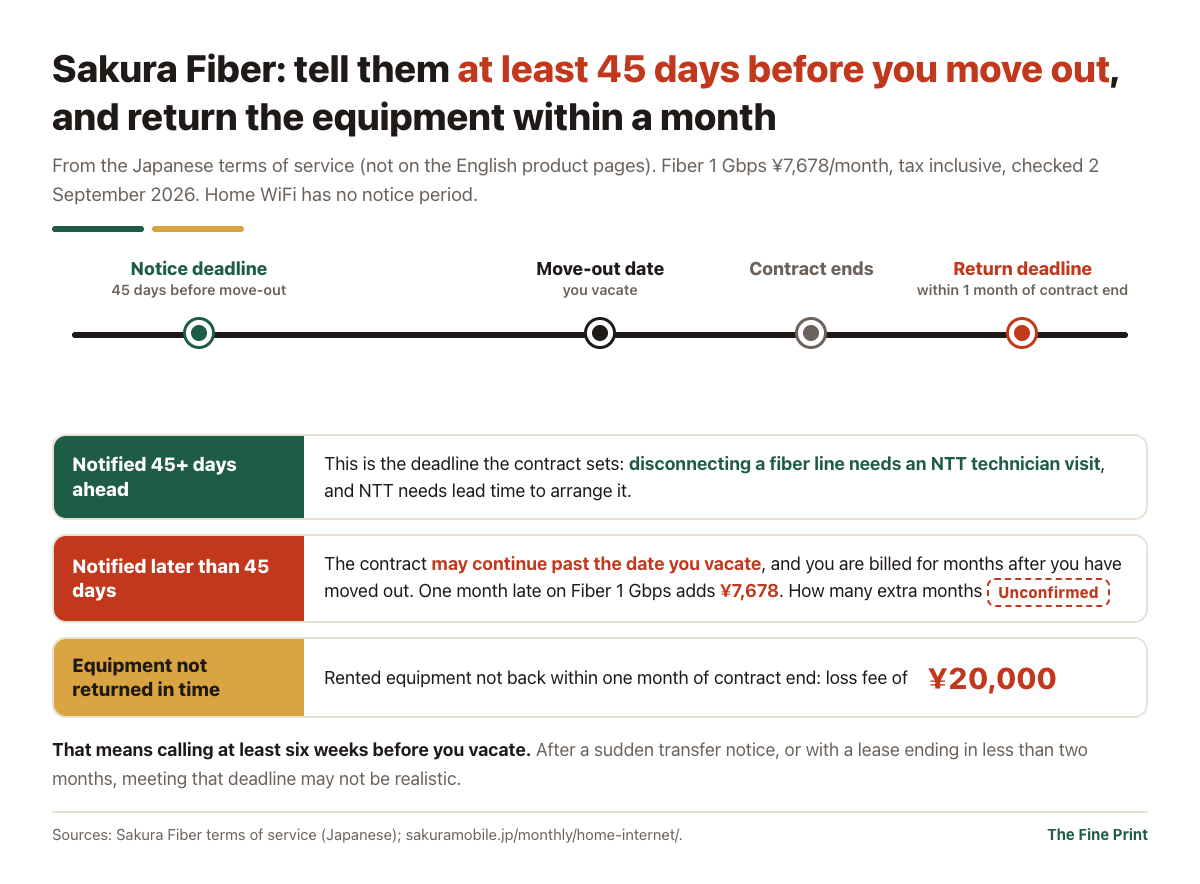
The fiber terms of service contain a notice period that does not appear on the English product pages.sm-fiber-tos
When you plan to move out, you must contact Sakura Fiber at least 45 days before your move-out date. The reason stated in the contract is NTT coordination: disconnecting a fiber line requires scheduling a technician visit, and NTT needs lead time to arrange this. If you notify later than 45 days out, the contract may continue past the date you vacate, and you will be billed for months after you have already moved out.
This clause is not unique to Sakura Mobile — it reflects how NTT fiber disconnections work across providers in Japan — but it is absent from most English-language descriptions of the fiber product. For a foreign resident who receives a sudden transfer notice from an employer, or whose lease ends without the typical two-month buffer, 45 days is a meaningful constraint.
After the contract ends, the rented equipment must be returned within one month. If the equipment is not returned within that window, a loss fee of ¥20,000 applies.sm-fiber-tos
Landlord permission and the installation process
By signing the contract, you are confirming that the property owner has already agreed to the installation work.sm-fiber-tos If your landlord has not given permission, do not apply.
Depending on building structure, installation may require a small hole in the exterior wall of approximately 10 mm to route the fiber cable inside. If your landlord is concerned about structural changes, Sakura Mobile has a bilingual team — Japanese and English — to assist with negotiation and translation of the permission process.sm-fiber-tos If your landlord communicates only in Japanese, this support channel is worth using before you apply.
The installation time after application ranges from one week to one month for the 1 Gbps plan and from two weeks to one month for the 10 Gbps plan.sm-home During that period, you are waiting without a home internet connection unless you arrange something separately — which the next section addresses.
The cooling-off period — what it does and does not cover
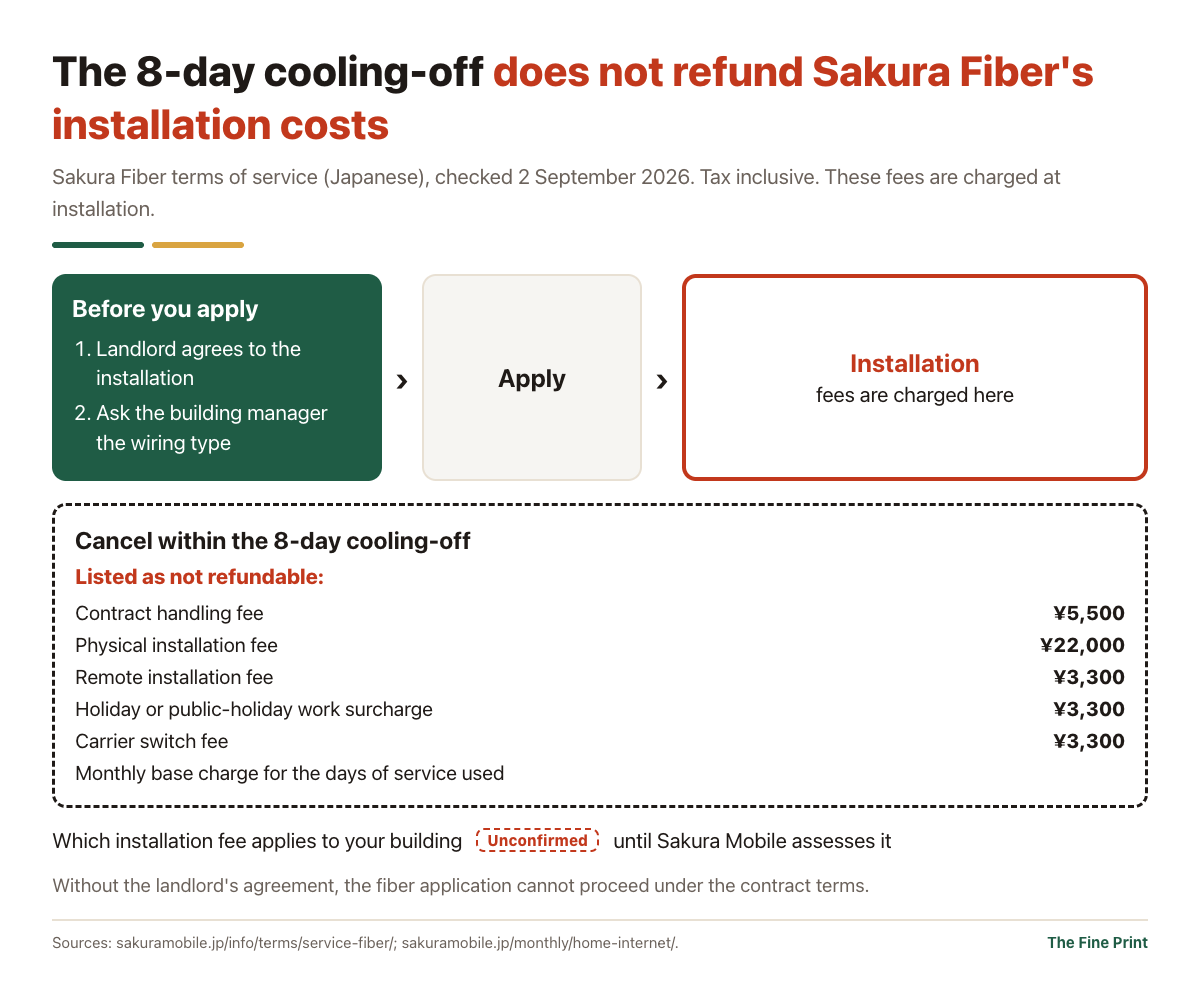
Japan's Telecommunications Business Law provides an eight-day cooling-off period for telecommunications contracts. For Sakura Fiber, the cooling-off period applies, but the following costs are explicitly listed as not refundable within that window:sm-fiber-tos
- Contract handling fee: ¥5,500
- Physical installation fee: ¥22,000
- Remote installation fee: ¥3,300
- Holiday or public-holiday work surcharge: ¥3,300
- Monthly base charge for the days of service used
- Carrier switch fee: ¥3,300
These fees are charged at the time of installation, not later. The cooling-off period does not undo them. Canceling within eight days after installation does not recover the installation cost. That makes it a meaningful financial risk to apply before confirming landlord permission or your building's wiring compatibility.
Who should not choose fiber
Avoid fiber if any of the following apply:
Your tenancy may end on short notice, or has a fixed end date within the next few months. The 45-day notice obligation means you need to schedule the termination call at least six weeks before you vacate. If your employer can relocate you quickly, or if your lease ends in less than two months, meeting that deadline may not be realistic.
Your landlord has not agreed to the installation, or you are renting a room in a share house where the building's internet is managed collectively. In those cases, the fiber application cannot proceed under the contract terms.
You expect to move within Japan in the next year or two. Each new address means a new set of installation costs, another waiting period, and another 45-day notice cycle. Multiple short stays make fiber progressively more expensive in total.
Your Apartment's Wiring Type — Check This Before Applying for Fiber
Before applying for Sakura Fiber, check what wiring infrastructure your building uses. Japanese apartment buildings — especially condominiums and multi-unit buildings built before the widespread rollout of fiber-to-the-unit — typically use one of three types: VDSL (over existing phone cable), LAN (building-wide Ethernet), or direct fiber to the unit. The type determines both the real maximum speed your unit can receive and the scope of the installation work.
Your building's wiring type sets the actual speed ceiling — a VDSL connection over older phone cable will not reach 1 Gbps regardless of the plan tier you sign up for. The official Sakura Mobile pages we could access during research do not specify which wiring type applies to which building. Ask your landlord or building manager which type your building uses before you apply. Sakura Mobile's English-language support team can also assess compatibility before you commit to an application.
Total Cost for 12 and 24 Months
Since the 1 Gbps monthly fee is the same for both products, the total cost difference over a stay comes from the initial fee and — for fiber — from the risk of one or two additional months of billing if the 45-day notice is not met. The tables below show only the confirmed initial fee range and monthly fees; they do not add any penalty months.
12-month total (initial fee plus 12 months of service, all tax inclusive)
| Plan | Minimum total | Maximum total |
|---|---|---|
| Home WiFi | ¥97,636 | ¥97,636 |
| Fiber 1 Gbps | ¥95,436 | ¥117,436 |
| Fiber 10 Gbps | ¥128,436 | ¥150,436 |
24-month total (initial fee plus 24 months of service, all tax inclusive)
| Plan | Minimum total | Maximum total |
|---|---|---|
| Home WiFi | ¥189,772 | ¥189,772 |
| Fiber 1 Gbps | ¥187,572 | ¥209,572 |
| Fiber 10 Gbps | ¥253,572 | ¥275,572 |
Calculations: Home WiFi initial fee ¥5,500 (fixed); fiber initial fee range ¥3,300–¥25,300. Monthly fee ¥7,678 for Home WiFi and fiber 1 Gbps; ¥10,428 for fiber 10 Gbps. All figures tax inclusive, verified September 2, 2026.sm-home
Sources: Sakura Mobile home internet pagesm-home. Checked 2026-09-02.
At minimum installation cost, the fiber 1 Gbps plan is marginally less expensive than Home WiFi over 12 months (¥95,436 vs ¥97,636) and over 24 months (¥187,572 vs ¥189,772). At maximum installation cost, fiber 1 Gbps runs ¥19,800 more than Home WiFi over 12 months and ¥19,800 more over 24 months. You will not know which installation category applies to your building until Sakura Mobile assesses it.
These totals do not include any extra months that would result from failing to give the required 45-day notice before vacating. If you are one month late in notifying — which is easy to do without a reminder — the actual 12-month total for fiber would increase by ¥7,678.
The Waiting-Period Bridge
When you apply for Sakura Fiber, the line will not be active for one week to one month. During that period, you need internet for work, banking, and day-to-day tasks.
The fiber terms of service cover this directly: Sakura Mobile provides a pocket WiFi device at no charge while the installation is pending.sm-fiber-tos You do not need to arrange a separate rental for the gap period, and the transition from temporary WiFi to fiber is managed within the same service.
If you are also setting up a monthly mobile SIM — for your phone, separately from home internet — Sakura Mobile's SIM plans run independently and can be arranged at the same time. The identity document requirements, payment options, and cancellation billing rules for the monthly SIM are covered in the related article: Best Monthly SIM for Foreigners Living in Japan 2026.
Two Alternatives to Consider for Home Internet in Japan
During research for this article, we could not confirm pricing or contract terms for any home internet provider other than Sakura Mobile. The alternatives below appear regularly in English-language guides for foreign residents in Japan. Verify current prices, contract lengths, and English-language availability on their official pages before making a decision.
GTN Internet (Global Trust Networks) offers home internet and SIM products marketed specifically to foreign residents and new arrivals in Japan. Their service includes both fiber and mobile router options. GTN has documented experience with applications from residents who are early in the visa or residency process. Check their official site for current monthly rates and whether application and customer support are available in English throughout the contract period.
If the Sakura Mobile fiber plan's 45-day notice period concerns you, it is worth checking whether GTN's fiber terms differ on this point — the notice requirement reflects NTT's disconnection process and may be similar across providers, but the exact terms are outside the scope of this article.
Standard Japanese ISPs using NTT Flet's — including providers such as NURO Hikari and SoftBank Hikari — offer fiber connections that may carry lower monthly fees than expat-focused services. Their sign-up processes, contracts, and customer service channels are in Japanese only. If you can navigate Japanese-language forms, have a Japanese-speaking colleague who can help, or use a translation service throughout the application, these providers may reduce your monthly cost. Their contracts typically include a fixed term with an early-termination fee — a different structure from the month-to-month billing Sakura Mobile uses for Home WiFi. Verify the current terms and fee schedule on the provider's official Japanese-language page before applying.
When to consider an alternative: if English-language support is not your main requirement and you are comfortable with Japanese-language contracts, a standard Japanese ISP may reduce monthly costs. If English support throughout billing and tenancy is a requirement, or you want to avoid long-term commitment structures, Sakura Mobile and GTN Internet are the two main options with documented English service for foreign residents in Japan.
How to Apply
Both Sakura Mobile home internet products can be applied for online in English. No Japanese bank account is required — Sakura Mobile accepts international credit cards issued outside Japan, including Visa, Mastercard, Discover, JCB, American Express, and Diners Club.sm-payment
For Home WiFi:
- Visit Sakura Mobile's home internet page (affiliate link — opens their home page; Home Internet is in the top menu): Check current Sakura Mobile home internet plans
- Select Home WiFi and enter your delivery address.
- Choose your preferred delivery date and a payment method.
- The router arrives by delivery; plug it in and connect.
For Fiber:
- Visit the same page and select Fiber.
- Before submitting an application, confirm with your building management or landlord that the installation is permitted and that fiber wiring is available for your unit.
- If you need help communicating with your landlord in Japanese, contact Sakura Mobile's bilingual support team before applying.
- Submit the application. Sakura Mobile coordinates with NTT to schedule the installation visit, which takes one week to one month for the 1 Gbps plan.
- Until the installation is complete, a pocket WiFi device is provided at no charge.sm-fiber-tos
The application is submitted in English. The terms of service exist in both Japanese and English; the Japanese version is the legally binding document, and this article draws from it for the cancellation and notice terms.
Summary for Home Internet in Japan for Expats
The monthly cost of Home WiFi and the 1 Gbps fiber plan is the same. The choice comes down to three questions: how certain are you about your stay length and end date, has your landlord agreed to installation work, and can your building receive fiber.
If your answer to any of those is "uncertain," "not yet," or "unknown," Home WiFi is the lower-risk option. It starts working within the delivery lead time, carries no cancellation fee, and requires no landlord negotiation or advance notice before you move.
If you plan to stay at the same address for at least a year, have landlord permission, and can confirm your building's fiber compatibility, the 1 Gbps fiber plan costs the same per month and delivers a wired connection that does not depend on mobile network conditions. The key obligations are the 45-day advance notice before vacating and the one-month window to return the equipment after the contract ends.
Both plans are billed in Japanese yen, require no Japanese bank account, and are supported in English throughout the contract period.
Check current Sakura Mobile home internet plans (affiliate link — opens their home page; Home Internet is in the top menu).
What we verified — and what we couldn't
What we verified
- Monthly fee of ¥7,678 (tax inclusive) for Home WiFi and Fiber 1 Gbps, confirmed on the Sakura Mobile home internet page.sm-homesm-home-price
- The 45-day advance notice requirement before vacating a fiber contract, confirmed in the Japanese terms of service.sm-fiber-tos
- Equipment return deadline of one month after contract end, and a ¥20,000 loss fee for failure to return within that period, confirmed in the Japanese terms of service.sm-fiber-tos
- Non-refundable fees within the 8-day cooling-off period: ¥5,500 contract handling, ¥22,000 physical installation, ¥3,300 remote installation, ¥3,300 holiday surcharge, ¥3,300 carrier switch fee, confirmed in the Japanese terms of service.sm-fiber-tos
- Accepted international payment methods (Visa, Mastercard, Discover, JCB, American Express, Diners Club), confirmed on the Sakura Mobile payment page.sm-payment
What we couldn't
- We could not find an official statement confirming the minimum number of months before cancellation is allowed for Home WiFi. The official page states monthly billing with no early-termination penalty but does not specify a floor. [U1]
- We could not find an official statement confirming the minimum usage period in months for Fiber. The terms state "minimum usage specified by our plan" without giving a specific number. [U3]
- We could not find an official source confirming which wiring type (VDSL, LAN-type, or direct fiber-to-unit) applies to which building categories. The government source at soumu.go.jp returned a 404 during research. [U4]
- We could not confirm GTN Internet's monthly pricing or contract terms from their official page during research for this article.
- We could not confirm monthly pricing or early-termination fees for standard Japanese ISPs from official pages during research for this article.
Sources
- Sakura Mobile home internet page, https://www.sakuramobile.jp/monthly/home-internet/, confirmed September 2, 2026. ↩
- Sakura Mobile home internet price section, https://www.sakuramobile.jp/monthly/home-internet/#price, confirmed September 2, 2026. ↩
- Sakura Mobile fiber terms of service, https://www.sakuramobile.jp/info/terms/service-fiber/, confirmed September 2, 2026. ↩
- Sakura Mobile payment methods, https://www.sakuramobile.jp/info/payment/, confirmed August 31, 2026. ↩